
For lead in drinking water, choose a filter with a documented lead-reduction claim and treat the water where you drink and cook. Our starting recommendations are AquaTru Classic for countertop reverse osmosis and Epic Smart Shield for under-sink carbon-block filtration. The right choice depends on your installation options, daily water use and maintenance routine.
We also compare Clearly Filtered’s pitcher and Waterdrop G3P800, with an important distinction: published laboratory testing is not the same as certification for lead reduction. A certification badge alone does not identify every contaminant a filter is certified to reduce.
If testing has found lead, contact your water utility or local health department about appropriate immediate steps. EPA guidance recommends using a filter certified to remove lead. Filtration should accompany investigation of the source.
Lead Water Filters at a Glance
| Filter | Where it fits | Lead evidence | Main tradeoff |
|---|---|---|---|
| AquaTru Classic | Countertop; no plumbing changes | Manufacturer documents IAPMO-certified lead reduction | Power, counter space and tank refills |
| Epic Smart Shield | Under sink; cold drinking-water tap | Manufacturer documents IAPMO-certified lead reduction | Installation and cartridge replacement |
| Clearly Filtered Pitcher | Portable pitcher | Independent lead testing; current NSF certifications cover other claims | Not our first choice when certified lead reduction is the priority |
| Waterdrop G3P800 | Tankless under-sink RO | Manufacturer labels lead as third-party tested | Confirm a lead-specific certification claim for the exact model |
Why We Prioritize Point-of-Use Filtration
Lead can enter water from service lines, solder, faucets and other plumbing. A whole-house filter at the building entrance cannot capture lead introduced by pipes or fixtures after that filter. EPA’s point-of-use guidance addresses this limitation. Protect the taps used for drinking and food preparation, including refrigerator water and ice when applicable.
A whole-house system may serve other treatment goals, but it is not our default recommendation for lead exposure at the kitchen tap. Choose the location and equipment around the actual source of contamination.
1. AquaTru Classic: Our Countertop Lead-Filter Pick

- No plumbing installation
- Requires power and tank refills
- Separate filter replacement schedules
AquaTru Classic is our starting choice when you want reverse osmosis without altering the plumbing. Its current product documentation identifies IAPMO certification to NSF standards for contaminant reduction, including lead. This is stronger evidence for a lead-focused purchase than an unqualified “tested to NSF standards” claim.
The Classic uses a refillable tap-water tank and a separate purified-water tank. It needs an outlet and counter space. That makes it a practical configuration to consider for renters or households that cannot install an under-sink system, provided everyone will keep up with refilling and cleaning.

The tradeoff is routine handling: you must refill the feed tank, discard the concentrated reject water and clean the tanks as instructed. Filters have different replacement schedules; do not treat one gallon rating as the life of every cartridge. Verify the current Classic manual and the exact filter package before ordering.
Choose it if: you want a countertop model with documented lead-reduction certification and can manage batch refills. Consider another setup if: you need continuous filtered water from the kitchen faucet or have little counter space.
2. Epic Smart Shield: Our Under-Sink Lead-Filter Pick

- IAPMO-certified lead reduction
- Connects to the cold-water line
- 651-gallon published capacity
The original Epic Smart Shield is a carbon-block system that connects to the cold-water line beneath the sink. Epic’s replacement-filter documentation identifies model EWFESS4 for system EWFESS4-DC, a 651-gallon capacity, and IAPMO R&T certification to NSF/ANSI 42, 53 and 401, including lead reduction.
This configuration suits households that want filtered water at the tap instead of repeatedly filling a pitcher. Confirm connections, available space and compatibility with your faucet before purchase. Epic also sells dedicated-faucet kits; select the installation you actually want.
Use the specified cartridge and follow its capacity and replacement instructions. Household usage varies, so “about a year” is not permission to exceed the gallon limit. Inspect connections for leaks and follow the manufacturer’s initial flushing procedure.
Choose it if: you want a documented lead-reduction option beneath the sink. Check carefully: the product and filter model. Smart Shield Max and other Epic products have their own evidence and should not inherit this model’s certification claims.
3. Clearly Filtered Pitcher: An Independently Tested Option

- No plumbing or electricity
- 100-gallon published filter capacity
- Manual refilling
Clearly Filtered publishes pitcher performance data reporting 99.34% lead reduction under its laboratory test conditions. That is useful evidence, but it is not an NSF certification for lead reduction or a guarantee that your tap will produce the same result.
The current pitcher page lists NSF/ANSI 42 certification for chlorine taste and odor and NSF/ANSI 372 for lead-free materials. Standard 372 concerns the product’s materials; it does not establish removal of lead from water. We therefore do not describe this pitcher as NSF/ANSI 53 certified for lead.
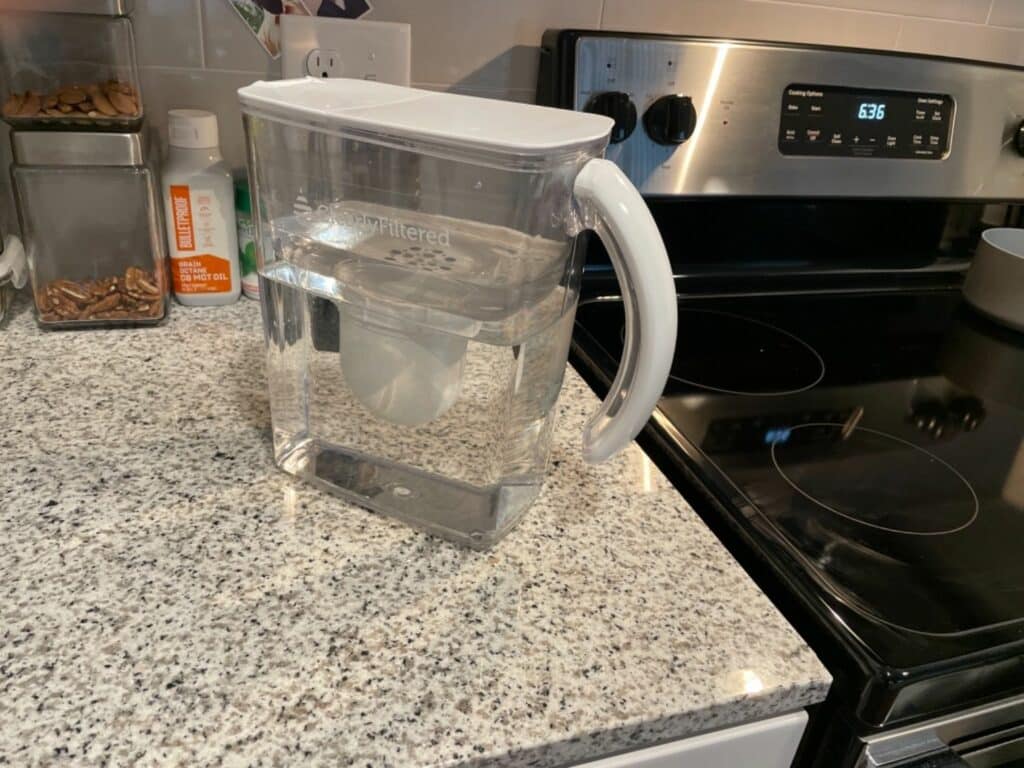


The pitcher needs no plumbing or power and has a published 100-gallon filter capacity. You still need to prime the filter, refill the pitcher and change cartridges as instructed. Its portability is convenient, but convenience does not replace lead-specific certification.
Our recommendation: if lead is confirmed or certified lead reduction is your main purchase criterion, prioritize a model whose current listing expressly includes that claim. Use the EPA filter-selection tool when comparing pitchers, rather than assuming every pitcher is equivalent.
4. Waterdrop G3P800: A Tankless RO Alternative

- Dedicated faucet and drain connection
- Requires electricity
- Lead testing distinct from other certifications
Waterdrop G3P800 is an under-sink reverse osmosis system with a dedicated faucet. The manufacturer’s current page lists IAPMO certification to NSF/ANSI 42, 53 and 58 for the claims on its performance data sheet, and 372 for low-lead materials. However, it marks lead reduction separately as third-party laboratory tested.
We do not interpret those standard numbers as proof of a certified lead-reduction claim. Before choosing this model specifically for lead, request the current performance data sheet and certification listing for the exact system and cartridges. Confirm that lead is included in the certified claims.
Installation needs space beneath the sink, a faucet location, a drain connection and electricity. Multiple cartridges have different replacement schedules. The faucet’s TDS display is not a lead test: it cannot tell you whether lead reduction is adequate.
Our recommendation: consider it as a tankless RO alternative after checking the exact evidence. For a straightforward lead-focused recommendation today, we give priority to AquaTru Classic and the original Epic Smart Shield above.
How to Compare Lead-Reduction Claims
- Check the exact model and cartridge. A brand’s certification does not automatically apply to every product it sells.
- Find lead in the certified claims. NSF/ANSI 53 and 58 cover multiple performance claims; the standard number alone is insufficient.
- Separate testing from certification. A laboratory report can show performance under test conditions without establishing an ongoing product certification.
- Read the operating limits. Check rated capacity, flow, replacement instructions and applicable feed-water conditions.
The EPA consumer tool describes identifying point-of-use and pitcher filters certified to reduce lead to 5 parts per billion or less, with fine-particle reduction under NSF/ANSI 42 Class I. That certification endpoint is not a promise of zero lead in every home. Review the current listing and obtain advice for your measured water conditions.
Before and After Installing a Filter
- Arrange tap-water testing through a qualified laboratory and follow its sampling instructions.
- Ask your utility or health department about the source, service-line status and any local advisory.
- Install and flush the filter as directed; replace cartridges on schedule.
- Ask about follow-up sampling of treated water and keep working toward removal of the lead source.
Use cold water for drinking and cooking and do not run hot water through these drinking-water filters. Boiling does not remove lead. Clear water and a good taste do not establish that lead is absent. EPA’s lead guidance explains these precautions and how to arrange testing.
Frequently Asked Questions
Does Every Water Filter Remove Lead?
No. A filter designed for sediment, chlorine taste or hardness may not have a lead-reduction claim. Check the exact system and replacement cartridge rather than choosing by brand, appearance or the word “carbon.”
Does Reverse Osmosis Remove Lead?
An appropriately selected RO system can reduce lead, as AquaTru’s documentation shows. Evaluate the specific model’s certified claims and operating instructions. “Reverse osmosis” describes a treatment process; it is not a substitute for checking the product evidence.
Can UV Light Remove Lead?
UV treatment is not a lead-removal stage. A system’s UV feature should not be counted as evidence for reducing this metal. Select the filtration stage against the lead-specific performance documentation.
Is a Whole-House Filter Enough?
It cannot address lead that enters water from plumbing downstream of the filter. For drinking-water exposure, evaluate treatment at the relevant taps and investigate the source. A separate whole-house system can be considered for other water problems.
Which Filter Should You Choose?
Start with AquaTru Classic for countertop use or the original Epic Smart Shield for under-sink use. Compare the current certification claims, installation needs and replacement costs before buying. A filter that everyone uses and maintains correctly is a better fit than a more elaborate system that does not match your household routine.
Sources & Product Documentation
- EPA: Lead in drinking water
- EPA: Identifying filters certified to reduce lead
- EPA: Point-of-use filtration and downstream plumbing
- AquaTru Classic specifications and certification claims
- Epic Smart Shield replacement cartridge and certification claims
- Epic testing and certification resources
- Clearly Filtered pitcher performance data
- Clearly Filtered pitcher specifications and current certifications
- Waterdrop G3P800 specifications and testing claims
