
The right restaurant water filter depends on the equipment it supplies and your incoming water. Ice machines, beverage dispensers, espresso machines and combi ovens can need different filtration, scale control or reverse-osmosis configurations.
The four options below are commercial product comparisons for different applications, not a universal ranking. Match them to the equipment manufacturer’s water specifications and have the final installation sized for peak demand. A residential filter’s advertised flow rate is not enough to establish restaurant suitability.
Best water filter systems for restaurants: compare by application
| Option | Commercial application | Documented starting point | Important limitation |
|---|---|---|---|
| Pentair Everpure QC7I Single 7FC5-S (EV920271) | Coffee brewers and ice machines | 2.5 GPM; 25,000-gallon rated capacity | Scale inhibition is not complete hardness removal |
| Solventum / Aqua-Pure BEV140 (5616201) | Cold beverage carbonator | Manufacturer lists approximately 2.5 GPM and 25,000 gallons | Do not transfer beverage suitability to espresso or steam equipment |
| BWT bestmax with compatible filter head | Coffee/espresso, vending and appropriate steam/combi applications | Size and bypass selected from the applicable water-hardness/capacity table | Cartridge alone is not a complete installed system |
| Pentair Everpure MRS-600HE-II (US EV997054) | Configured RO/blended supply for multiple foodservice applications | 600 GPD nominal RO production; actual delivery depends on configuration | Daily production is not an instantaneous service-flow rating |
Rated capacity does not establish how many years a filter will last in your restaurant. Follow the exact system’s replacement interval, water-use limit and service indicators, whichever requires action first.
1. Pentair Everpure QC7I Single 7FC5-S: coffee and ice filtration
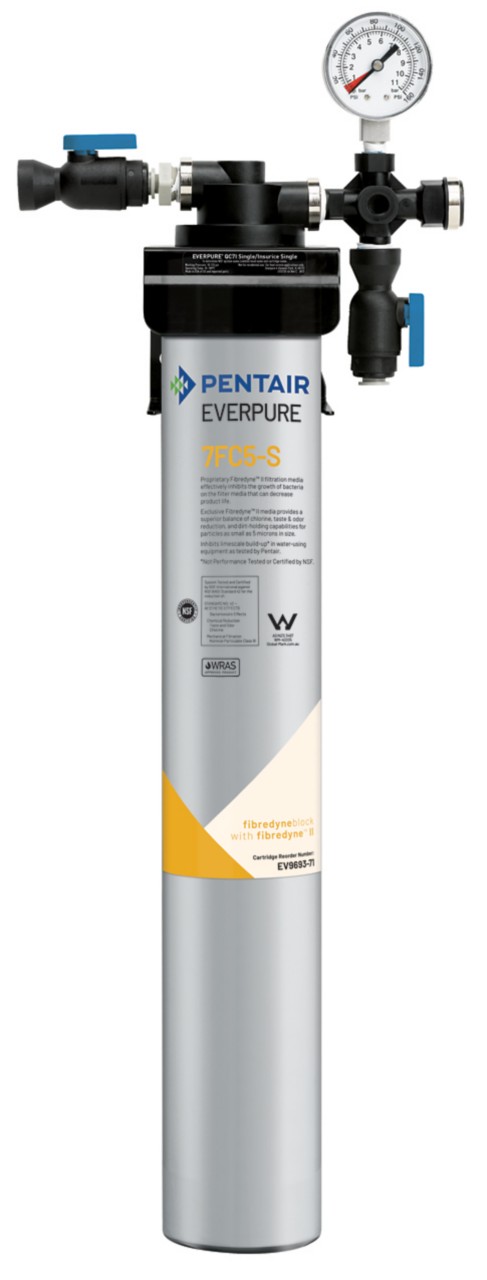
The QC7I Single 7FC5-S is a documented commercial choice for coffee brewers and ice machines. Its exact-model specification sheet lists a 2.5-GPM service flow and 25,000-gallon capacity, chlorine taste-and-odor reduction, particulate filtration and scale inhibition.
The sheet identifies NSF/ANSI 42 certification for specific aesthetic and bacteriostatic claims. Bacteriostatic media control growth within the filter; they do not make microbiologically unsafe source water safe. This model is not a complete ion-exchange softener or a universal filter for dissolved contaminants.
Confirm the required peak flow, water pressure and whether this scale-control approach meets your equipment’s requirements. The specification sheet recommends scheduled cartridge replacement, replacement when capacity or adequate flow is exhausted, and at least annual replacement. Higher demand may require a different FC configuration.
2. Solventum / Aqua-Pure BEV140: cold-beverage filtration
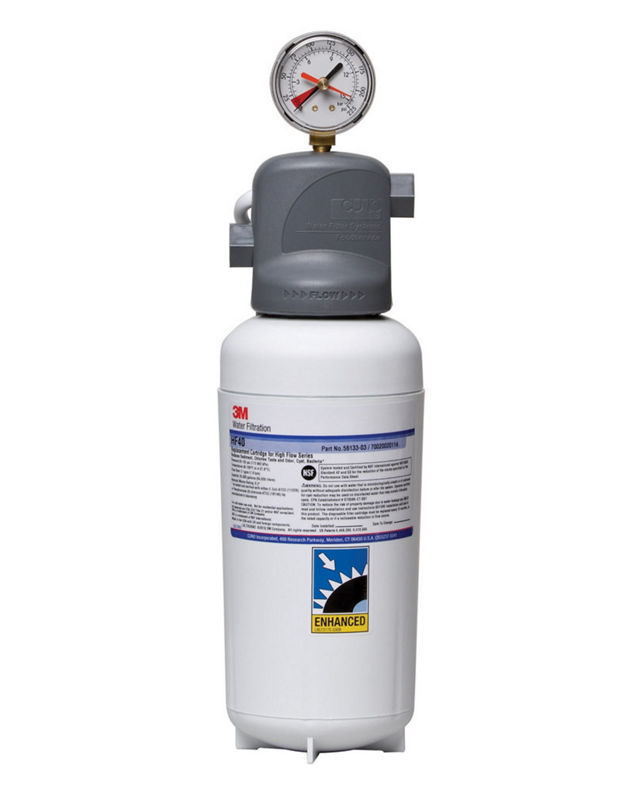
The BEV140 system, catalog number 5616201 is intended for commercial cold-beverage carbonator applications. Solventum lists approximately 2.5 GPM, 25,000-gallon capacity and a 0.2-micron nominal rating, with particulate and chlorine taste-and-odor treatment.
You may still encounter 3M branding while these water-filtration products transition to Aqua-Pure. Match the catalog number and included head/cartridge, rather than assuming every similarly named replacement is the full system. The manufacturer also describes specific microbial-reduction testing, which should not be generalized into a guarantee of safe water from an unsafe source.
Choose it for the beverage application it is documented to serve. If you also need hardness reduction for espresso or steam equipment, obtain a separate compatible treatment design. Confirm the current operating limits and installation requirements with the supplier.
3. BWT bestmax: application-specific coffee and steam water treatment
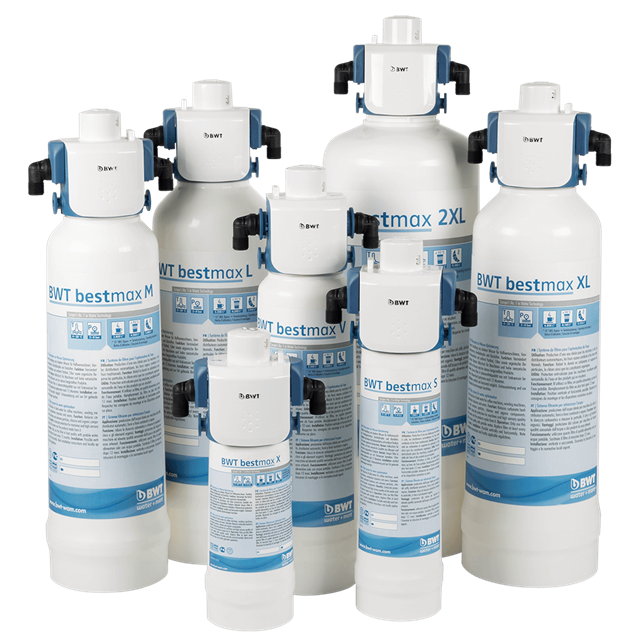
BWT bestmax is a commercial filtration family used in hospitality for coffee, vending and suitable oven/combi-steamer applications. BWT describes reductions in hardness-forming calcium and magnesium, particles, chlorine and off-flavor substances.
It is not one fixed-capacity model for every restaurant. The cartridge size and bypass setting depend on water hardness, application and consumption. Use the applicable capacity table and equipment water specification instead of converting one published capacity into a universal replacement interval.
Confirm that the quote includes the compatible filter head, fittings and any monitoring needed, not merely a replacement cartridge. Where the equipment requires different mineral control, chloride or silica limits, ask the equipment supplier whether bestmax is sufficient or another treatment process is needed.
4. Pentair Everpure MRS-600HE-II: configured commercial reverse osmosis
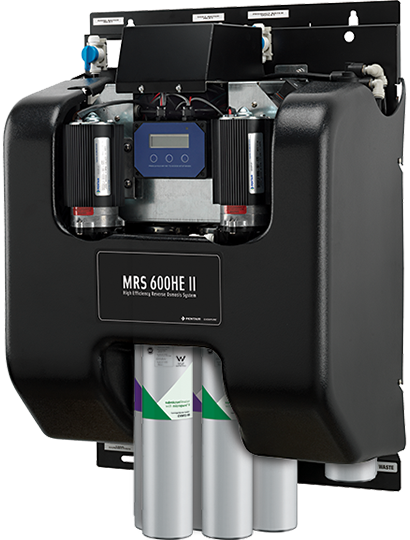
The Everpure MRS family provides configured RO and blended filtered-water options for foodservice. The MRS-600HE-II specification sheet identifies coffee, espresso, steamers, combi ovens and ice applications, with 600-GPD nominal production for this model.
Do not treat that daily-production figure as the flow available at a tap during the lunch rush. Actual output and delivery depend on incoming water, blending, storage, line size and pressure. A complete proposal must specify the processor, storage arrangement, feed treatment, drain and electrical requirements.
RO can be appropriate when the equipment needs dissolved-mineral reduction beyond what a simple carbon filter provides. Have the finished water and blending configured to the equipment’s specifications; lower TDS is not automatically the best water for every beverage or machine. Obtain the current written warranty for the quoted system, including replaceable-element exclusions.
Commercial whole-premises filtration versus equipment filtration
A restaurant may need a professionally sized point-of-entry system, equipment-specific filters, or both. A whole-premises system treats the main supply, while a point-of-use system treats the water feeding a particular beverage dispenser, coffee machine or other appliance.
Size the main system for simultaneous demand, including equipment filling and other water uses. Do not translate a household bathroom rating or a residential 15-GPM claim into a number of restaurant sinks. Pressure loss, operating flow, water chemistry and the equipment’s minimum supply requirements all affect selection.
Carbon filtration, ion-exchange softening, scale inhibition and reverse osmosis serve different purposes. A salt-free conditioner is not equivalent to a softener that removes hardness. Your equipment may require hardness removal or other water-quality limits that conditioning alone cannot establish.
How we compare restaurant water filter systems
We prioritize a documented foodservice application, exact-model performance and compatibility with the equipment being served. Price, warranty and maintenance matter after the system is suitable for the job. We have not performed an on-site test of these four systems in your restaurant.
| Compare | What to obtain before purchase |
|---|---|
| Water chemistry | Source water information plus the measurements required by your equipment and treatment supplier |
| Peak demand | Required flow and pressure during simultaneous operation; storage recovery for RO |
| Treatment scope | Specific reductions, scale-control mechanism and exact-model test/certification documentation |
| Installed cost | Complete system, fittings, head/manifold, storage, plumbing, commissioning and service |
| Maintenance | Cartridge/media/membrane costs and intervals, monitoring and planned service access |
| Warranty | Written coverage for the specific commercial application, installation and service conditions |
Advantages of restaurant water filtration
Appropriate filtration can improve beverage taste, reduce troublesome sediment and help manage equipment scale or other water-related operating problems. Those benefits depend on selecting and maintaining the right treatment; a filter is not a blanket guarantee that every contaminant is removed.
Disadvantages and running costs
Budget for consumables, servicing, space, commissioning and pressure loss. RO also requires a wastewater drain and a suitable storage or delivery design. Replacement frequency depends on actual demand and incoming water rather than a residential estimate. Compare the installed and recurring costs of complete proposals instead of stale advertised prices.
Frequently Asked Questions
No. Start with the water supply and the requirements of the equipment you operate. A carbonator, espresso machine and combi oven may need different treatment and flow. A properly documented supply and equipment specification should guide the choice.
Do not assume residential marketing, a high contaminant count or a large advertised daily output establishes commercial suitability. Obtain manufacturer confirmation covering the intended duty, capacity, installation and warranty before using a residential model for commercial equipment.
That depends on the job. A dedicated beverage filter may cost less to install than a configured commercial RO system, but they solve different problems. Obtain quotes for systems that meet the same equipment and water requirements, including the components and service costs needed to operate them.
Follow the exact manufacturer’s time interval, treated-volume limit, flow/pressure indicators and application-specific service requirements. High restaurant demand can reach the capacity limit sooner than household use. Keep a dated service record and check performance after maintenance.
Do not assume so. Ordinary taste-and-odor filtration is not a substitute for a safe potable supply or a properly designed disinfection process. If the source is under an advisory or has a confirmed safety problem, address that problem before treating the filter as sufficient protection.
Conclusion
For coffee brewers and ice machines, compare the appropriate Everpure FC configuration. For a cold-beverage carbonator, evaluate the BEV140. For coffee or suitable steam applications needing targeted water treatment, compare a correctly sized BWT bestmax system. When multiple machines need configured mineral reduction and blending, obtain a commercial RO proposal such as the Everpure MRS family.
Choose the complete system after confirming source water, equipment requirements, peak demand, maintenance and commercial coverage. That produces a more useful restaurant recommendation than choosing a residential filter solely from its advertised flow rate or lifetime warranty.
