
The best water testing kit depends on your water source and the question you need answered. For a broad check of public-supply water at home, our pick is Tap Score Advanced City. For a private well, start by comparing a baseline laboratory panel with local health-department recommendations; pay for specialized testing when your location or symptoms justify it.
Laboratory analysis and DIY screening serve different purposes. A strip can help check hardness or another listed parameter, but a reassuring color change does not establish that your drinking water is safe.
This guide compares current manufacturer specifications, sampling requirements and report features. It does not claim hands-on testing of every kit. Affiliate disclosure: WaterDefense may earn a commission from purchases made through some links below.
Our Water Testing Kit Picks
| Kit | Best fit | Important limit |
|---|---|---|
| Tap Score Advanced City | Broad city-water laboratory panel | Confirm separate testing for concerns outside its analyte list |
| Tap Score Essential Well | Baseline private-well laboratory testing | Does not cover the broader organic-chemical panel |
| Tap Score Extended Well | Well testing with selected specialized additions | A costly option; targeted add-ons may be more economical |
| Safe Home Ultimate In-Lab | Broad chemistry panel as an alternative | Included DIY bacteria test is separate from lab chemistry |
| JNW Direct Hardness Strips | Quick hardness screening | Does not test drinking-water safety |
Product panels and packaging can change. Check the exact kit’s current analyte list, lab fees and shipping requirements before ordering. A count may include physical properties, calculated values and self-tests as well as contaminants; larger totals are not directly comparable.
1. Tap Score Advanced City: Our Pick for City Water
Recommended for a broad city-water check

Tap Score currently lists 111 analytes for Advanced City, including lead, arsenic, other metals, hardness, nitrate/nitrite, volatile organic compounds and selected disinfection byproducts.
The package includes sample-collection materials, standard shipping and an interactive report with result explanations and treatment guidance. The listed lab turnaround is five business days; delivery and sample transit add time.
Before buying: check whether your specific concern appears on the list. Do not assume this city-water panel includes PFAS or laboratory bacteria testing.
Public water is monitored by your supplier, but a sample from your own tap can investigate household plumbing or a specific water-quality concern. Read your utility’s Consumer Confidence Report first, then choose tests that answer what that report cannot tell you about your faucet.
2. Tap Score Essential Well: A Baseline Well-Water Option
Start with the baseline panel and local guidance
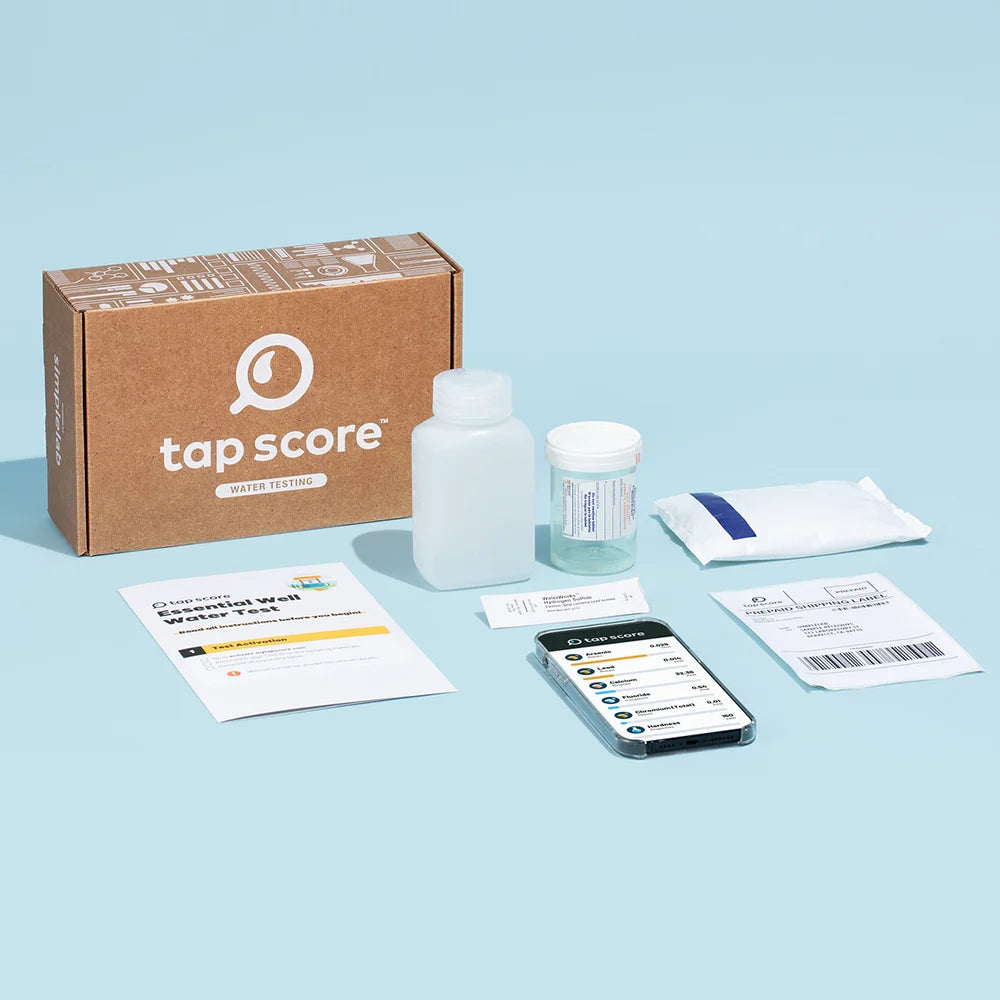
Essential Well currently lists 54 analytes, including total coliform, E. coli, nitrate/nitrite, pH, total dissolved solids, hardness and metals such as iron, manganese and arsenic.
Tap Score lists five business days at the lab and included standard shipping. Follow the kit’s collection, cooling and return instructions closely, especially for bacteria samples.
Coverage limit: this is a baseline panel. Ask about additional local risks and tests for organic chemicals or PFAS when those are relevant.
A local certified laboratory may also offer an economical annual panel. Ask your health department which tests are appropriate for your area before assuming you need a large mail-in package.
3. Tap Score Extended Well: For Broader, Specific Concerns
Consider when the additional tests match your risks

Extended Well currently lists 142 analytes. It combines the Advanced Well panel with specialized testing for PFAS, tannins and radioactive particles.
The manufacturer lists overnight return shipping with insulated coolers and an estimated 12 business days at the lab. This is not an immediate answer to suspected contamination.
Cost check: compare the complete panel with a baseline kit plus targeted tests. Extended Well is a premium option, not our default recommendation for every annual well check.
If your main concern is petroleum compounds or other volatile organic chemicals, compare Tap Score Advanced Well before paying for the Extended panel. Match the included compounds to nearby activities and the advice of your local health department.
4. Safe Home Ultimate In-Lab: A Broad Chemistry Alternative
Compare the chemistry panel and bacteria-testing method

Safe Home lists 200 parameters for its Ultimate In-Lab kit, covering metals, physical properties, inorganics and a wide range of organic compounds. Included values and calculated properties should not be treated as 200 separate health hazards.
The manufacturer says the lab fee and U.S. return shipping are included, with results typically available in seven to ten business days, excluding sample transit, weekends and holidays.
The included bacteria kit is a separate DIY test. If you need a certified laboratory bacteria result, arrange that explicitly rather than treating the bundled self-test as equivalent. Confirm the seller’s package matches the current Ultimate In-Lab kit.
5. JNW Direct Hardness Strips: For Quick Hardness Screening
A convenient hardness check

JNW Direct’s hardness strips offer a quick color-chart reading for tap, well or softened water. They can help screen for hardness and compare water before and after a softener.
Read the scale, units, timing and storage instructions on your actual container. For a treatment-sizing decision or a precise low-level measurement, use an appropriate titration kit or laboratory measurement.
Limit: hardness strips do not identify lead, bacteria, PFAS or other drinking-water hazards. Soft water is not automatically safe water.
General multi-parameter DIY kits can be useful for screening only the parameters they actually measure. For suspected lead or bacterial contamination, use an appropriate laboratory test and public-health guidance rather than relying on a strip or a negative home test alone.
How to Choose the Right Test
- Start with the source. City water, a private well and a rainwater system have different risks. A panel designed for one is not automatically suitable for another.
- Name the question. Hardness, plumbing-related lead, discoloration, bacteria, pesticides and PFAS require different tests. Odor and appearance cannot identify everything present.
- Check the actual analytes. Look for your specific contaminant, method and reporting limit. A broad kit may omit the one thing you want to measure.
- Confirm certification when required. Ask whether the laboratory is certified for the relevant drinking-water methods and whether its report meets your local or transaction requirements.
- Compare the full cost. Include the lab fee, return shipping, cooling supplies, add-ons and any follow-up sample. A cheap collection kit can have a separate analysis charge.
Sampling Matters as Much as the Kit
Contact the laboratory before sampling if you need to compare untreated water with filtered water or investigate lead from household plumbing. Different goals may require different taps, stagnation periods, flushing procedures or separate sample sets. A sample taken after treatment does not characterize the raw supply.
Use the supplied bottles and follow the instructions for each test. Do not rinse a preserved or sterile bottle unless directed. Plan collection around the lab’s receiving hours and shipping deadlines; bacteria and other time-sensitive analyses can require cooling and rapid delivery.
If contamination is suspected after flooding, a spill or a sudden change, contact your health department or water supplier promptly and follow its drinking-water advice. Do not wait for a routine mail-in panel to decide how to respond to an active advisory.
How to Read the Results
Review the individual measurements, units and reporting limits. A report score is a summary, not a substitute for the results. “Not detected” means below the method’s reporting limit; it does not mean that every possible contaminant is absent.
Distinguish enforceable public-water standards, health-based guidance and aesthetic or operational benchmarks. A private-well result may be compared with public-system standards for context without making it a regulatory compliance determination. Ask the lab or health department to explain a concerning result.
Choose treatment for the contaminants actually measured and verify the exact product’s performance claims. After installation, test treated water for the target contaminants under the laboratory’s recommended sampling plan. Our water contaminant guides explain common treatment options.
Frequently Asked Questions
For private wells, CDC recommends annual testing for total coliform bacteria, nitrates, total dissolved solids and pH. Your health department may recommend additional local tests. Test again after flooding, repairs or changes in taste, odor or appearance. For city water, review the utility’s annual report and arrange household testing for specific concerns such as plumbing-related lead; there is no single broad annual panel appropriate for every home.
Check the concentration, units and benchmark for that specific substance. Health guidance, public-water regulations and aesthetic recommendations serve different purposes. Ask the laboratory or health department to interpret concerning findings and advise on immediate use of the water. Do not rely only on a color code or overall score.
Identify the impurity and its concentration first, then select treatment with verified performance for that contaminant and your water conditions. Our contaminant guides describe common options. Retest treated water to confirm the intended result and maintain the system as instructed.
Safe Home Ultimate lists 200 parameters, the largest advertised total among the laboratory kits compared here. That total includes physical properties and other values; it is not directly comparable with every brand’s analyte count. Choose coverage for your actual risks rather than the largest headline number.
It depends on the concern. Tap Score Advanced City suits a broad city-water check; Essential Well offers a baseline well panel; Extended Well adds selected specialized analyses. Safe Home Ultimate and CityCheck Deluxe cover different chemistry panels. Compare the analyte lists and sample reports, not a universal claim that one kit covers everything.
There is no useful single average across hardness strips, targeted lab tests and broad laboratory panels. Compare the current total price, including analysis fees, return shipping and add-ons. Specialized testing can cost substantially more than a basic screen.
Our Recommendation
Use Tap Score Advanced City when its panel fits your municipal-water concerns. For a well, begin with local guidance and a suitable baseline lab panel, then add specific tests when justified. Keep DIY strips for quick operational checks, and use properly collected laboratory samples for decisions about drinking-water contaminants.
Additional Comparison: CityCheck Deluxe
Additional comparison reference
National Testing Laboratories CityCheck Deluxe
The current product page lists 115 analytes, including metals/minerals, inorganics, physical factors, disinfectants/byproducts, volatile organic compounds, and pesticides, herbicides and PCBs.
National Testing Laboratories estimates 10–12 business days from sample receipt. Sample return shipping is not included; its instructions call for guaranteed next-day delivery. Arrange the label and collection date before sampling.
This is sold as an informational testing package. For a mortgage, property transaction, legal dispute or regulatory requirement, ask the laboratory which panel, certification and documentation are acceptable before ordering.
